

ContextLogic is building a portfolio of high quality niche businesses and there is a good case to be made that this is just the first inning of a long game.
ContextLogic Holdings Earnings Update
Context Logic reported Q2 earnings on June 30, and the results were optimally ugly, but it was almost entirely a function of acquisition accounting and a time shutdown. US Salt was their only operating business in the reporting period.
Revenue was flat while volume declined due to a planned factory shutdown, which apparently occurs every 2-3 years at US Salt. The reason revenue was flat was because average selling prices increased 7.7%. Gross margin didn’t expand; in fact, it decreased slightly, meaning that the 7.7% increase in prices was not enough to offset the increase in natural gas costs, which is a meaningful input in their production.
Adjusted EBITDA declined by $3.2m, but $2.5m of it was due to parent company (Context Logic) overhead that simply did not exist a year ago. Net income swung to a loss of $6.3m, mostly due to amortization of intangibles, which is just from the stepped-up asset base. FCF was also negative, which is also entirely explained by the deal costs. On a more positive note, interest expense is down, and they were successfully able to raise prices.
The market reacted favorably presumably because they just recently announced another acquisition and because of the impressive pricing power of US Salt. In reality, earnings reports are goin to be a bit messy for a while and investor will need to be patient and read through the noise over the next few quarters/years.
Ok, now I want to talk about the quality of US Salt and their next acquisition gChem, to bring a little context to the markets favorable reaction to both of the acquisitions.
US Salt
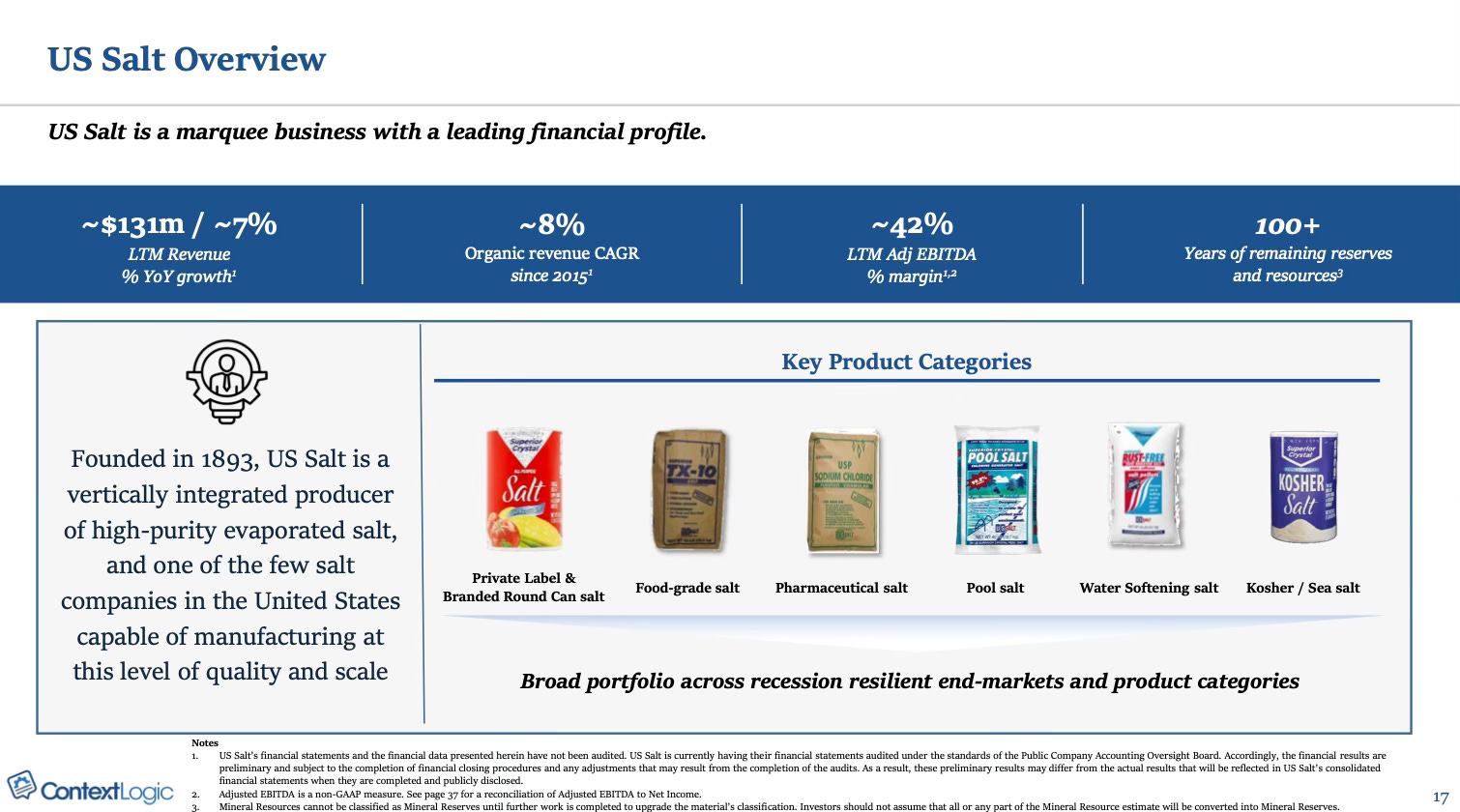
When talking about the quality of US Salt, the absolute best place to start is the DOJ antitrust complaint from 2021. The Department of Justice sued to block Stone Canyon’s acquisition of Morton Salt because it owned US Salt and combining it with Morton would create a monopoly. On thing I like about these DOJ anti-trust complaints is they provide a very good understanding of the companies competitive position and how the company works. In this particular complaint the DOJ detailed why this industry really has no meaningful competition, and why building a new facility to compete is almost impossible.
The Pharmaceutical-Grade Salt Near-Monopoly
Morton and US Salt are the only two suppliers of pharmaceutical-grade salt in the United States and Canada, with Morton holding roughly 77% market share and US Salt a share of around 23%.
The acquisition would have given the combined firm a monopoly in the sale of pharmaceutical-grade salt in the United States and Canada.
“Together, Morton and US Salt would have a monopoly in the United States and Canada for pharmaceutical-grade salt, the purest grade of evaporated salt, which is used to make life-saving treatments and products for patients in need of dialysis fluid, intravenous saline solution, or other medical products.”
"Morton and US Salt are the only two suppliers of pharmaceutical-grade salt in the United States and Canada, with Morton currently having a market share of around 77% and US Salt a share of around 23%." -DOJ complaint
This is why ContextLogic paid up the for the acquisition and its also why the company has been able to maintained steady pricing power for decades, as I detailed in my initial writeup.
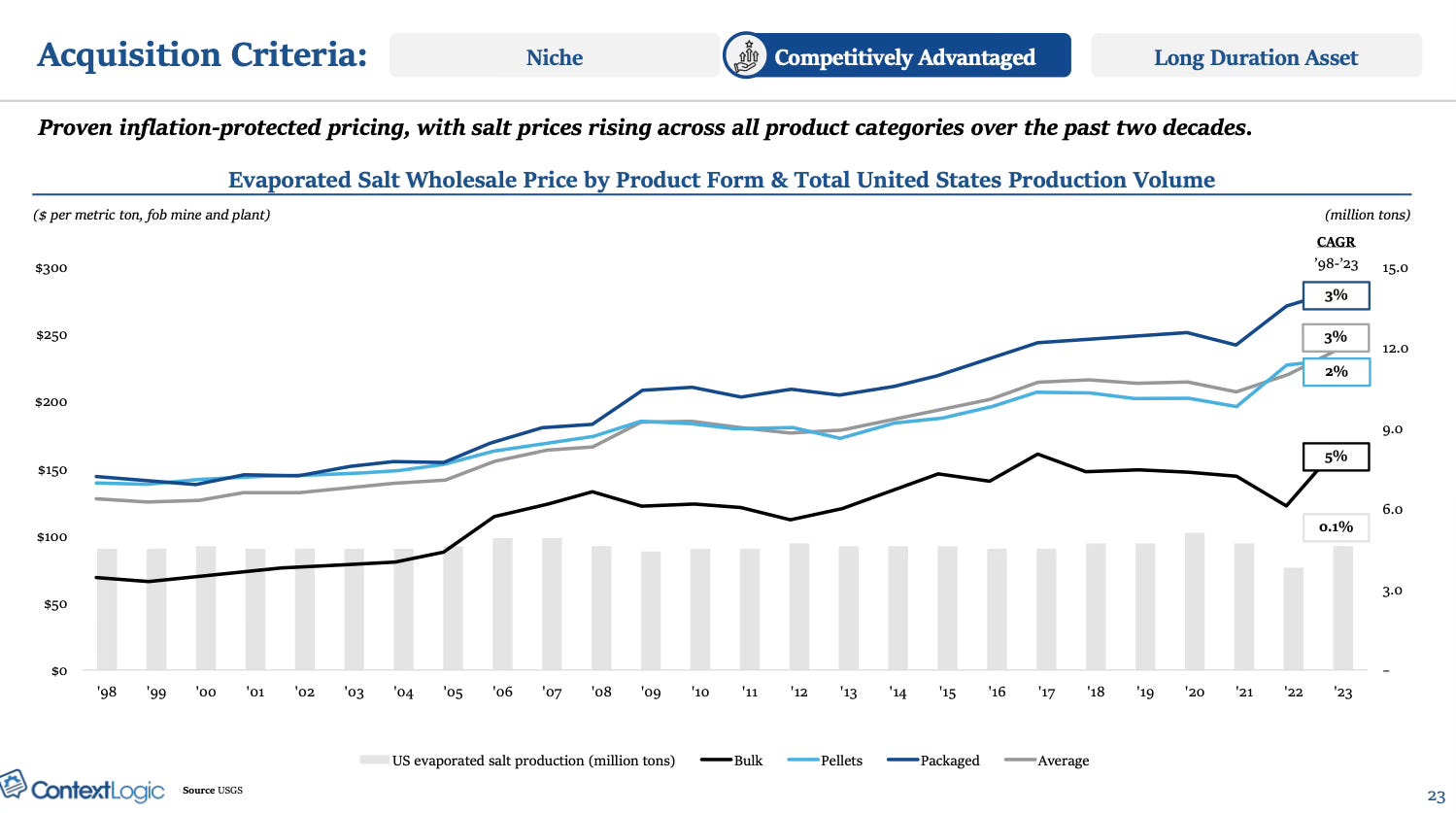
So what makes pharmaceutical-grade salt so difficult to produce? It’s the grade of salt with the highest percentage of sodium chloride and thus the purest grade of evaporated salt, used as a building block for a number of life-saving treatments and products, including dialysis fluid, intravenous saline solution, and other medical products. The purity requirements are extremely high.
“Pharmaceutical-grade salt must be evaporated from salt deposits of extremely high purity then undergo post-production processing to ensure that it contains virtually no trace minerals or other impurities.” -DOJ complaint
There’s also a documentation burden that creates its own competitive advantage. The mining and production process for pharmaceutical-grade salt must be extensively monitored and documented to ensure purity and consistency across production batches. This documentation must then be provided to customers as a validation of the quality and purity of the pharmaceutical-grade salt.
Why does this matter for an investor? Because pharmaceutical companies are extraordinarily risk-averse about their input materials, and so owning a company that provides those inputs provides a durable advantage that keeps competition away. The DOJ addresses this directly:
“Reputational barriers make entry even more difficult, as customers would be reluctant to switch to an unproven supplier that could not guarantee access to high-quality pharmaceutical-grade salt.”- DOJ complaint
Why Nobody Can Just Build a New Evaporated Salt Facility
Even if a new competitor somehow acquired a salt deposit of sufficient purity (rare), obtained necessary permits, built a facility, and obtained ongoing financing for CapEx, it would still take years to accumulate the track record necessary to win a single pharmaceutical customer.
This means it’s highly unlikely that entrants would be incentivized to spend large amounts of time and money on something that still has a high probably of not paying off. A pharmaceutical company sourcing an input for dialysis fluid is not switching to an unproven vendor to save a few percent on cost. The liability exposure alone makes it irrational. Contaminated dialysis fluid would be an absolute catastrophe of biblical proportions for any pharmaceutical company.
The DOJ recognized this by concluding that entry from a competitor would not be “timely, likely, or sufficient to mitigate the anticompetitive effects.” And while this statement was directed at the hypothetical monopoly of US Salt and Mortons, it’s reasonable to assume it’s also apples to both individually, at least to some extent. This explains why no new evaporated salt facility has been constructed in the United States in over 20 years. It crazy to think that for over two decades, with a profitable, high margin industry sitting right there, nobody has built a new facility. Incredible.
For bulk evaporated salt in the Northeast specifically, the barriers can be even higher. Entry into bulk evaporated salt in the northeastern United States is particularly difficult because this area has limited salt deposits, which are necessary to serve the market. You can’t build a facility wherever you’d like. The geology constrains you to specific locations, and those locations are already occupied.
The Geographic Freight Advantage
I touched on this in my original piece. US Salt’s facility is located in Watkins Glen, New York. As I noted, this gives them a dominant freight position across the entire Northeastern U.S. and Mid-Atlantic corridor. The DOJ complaint explains precisely why geography matters so much here.
"Bulk evaporated salt is a product that can be produced at a relatively low cost, but it is heavy and therefore expensive to transport. As a result, customers purchase from nearby suppliers to minimize shipping costs that can be high relative to the value of the bulk evaporated salt being purchased."- DOJ complaint
The consequence is a market that is effectively sealed off from competition.
"Both Morton and US Salt — along with only one other competitor — operate bulk evaporated salt production facilities in upstate New York. All three companies use these facilities to service customers in the northeastern United States, including Connecticut, Delaware, Maine, Massachusetts, New Hampshire, New Jersey, New York, Pennsylvania, Rhode Island, and Vermont. Customers in the northeastern United States can economically procure bulk evaporated salt from only these three locations. Other more distant bulk evaporated salt facilities cannot compete successfully on a regular basis for customers in the northeastern United States because the suppliers are too far away, making transportation costs too great."-DOJ complaint
Round Can Table Salt
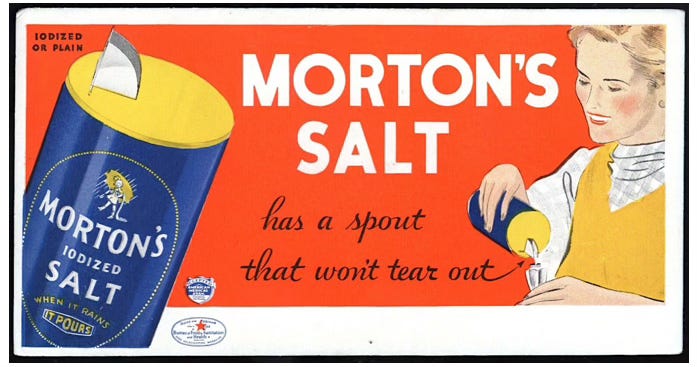
When you see a white label round can like Great Value (Walmart), or another grocery store’s generic brand, its highly likely that its packaged by US Salt. US Salt controls 90% of that specific white label market. 1
For some strange reason, round can table salt is the preferred way that Americans want their salt packaged. I’m not entirely sure if it’s the storage convenience or the small metal tab that folds out to pour, but whatever it is, Americans simply like it. Approximately 95% of the table salt sold to consumers in the United States is sold in a round can, with US Salt and Mortons controlling it almost entirely.
The interesting part is that the barrier to entry here has an almost absurd quality to it.
"The packaging process for round-can table salt, created decades ago, is based on technology from that era and has proven to be difficult to replicate in a price-competitive manner. As a result, potential entrants with access to suitable salt deposits have tried, and failed, to develop round-can packaging technology in the last five years."- DOJ complaint
So the moat is actually an irreproducible historical moat, which is the opposite of a technological moat. Entrants failed because modern custom tooling and engineering costs/rules could not produce the cans at a price that would allow them to compete with Morton and US Salt, which have fully amortized, legacy equipment. It’s just not feasible.
Of course, this moat would cease to exist if consumer simply began buying salt that came in bags or plastic containers, but that has not been the case for over a 100 years since the round can was invented.
gChem
Admittedly, I know lesa bout gChem than I do US Salt because the DOJ didn’t produce a report on it. However, I think I understand the basics and the essential nature of the business.
gChem is the renamed Gaylord Chemical Company, which commercialized chemical called DMSO in the early 1960s. DMSO is a solvent that has become increasingly popular in the pharmaceutical, chemistry and semiconductor industry. DMSO dissolves chemicals and acts for of like a “freeway” for chemical reactions. It speeds up chemical reactions that would normally take days with other solvents like water or ethanol. performs jobs that no other single substance can pull off as safely or efficiently in drug discovery, cell biology and medicine and other chemically focused industries.
DMSO appears to be a boring commodity type business at first glance. However, operating income grew at a 19.2% CAGR from $17m in 2019 to $52m 2026 from mix and pricing. This should be an indicator to anyone reading that this is a specialty chemicals business rather than a simple commodity business.
The other interesting thing is that there are only three global DMSO manufacturers at scale, including gChem, and gChem basically owns the western hemisphere because the other two producers are in Asia.
Moats
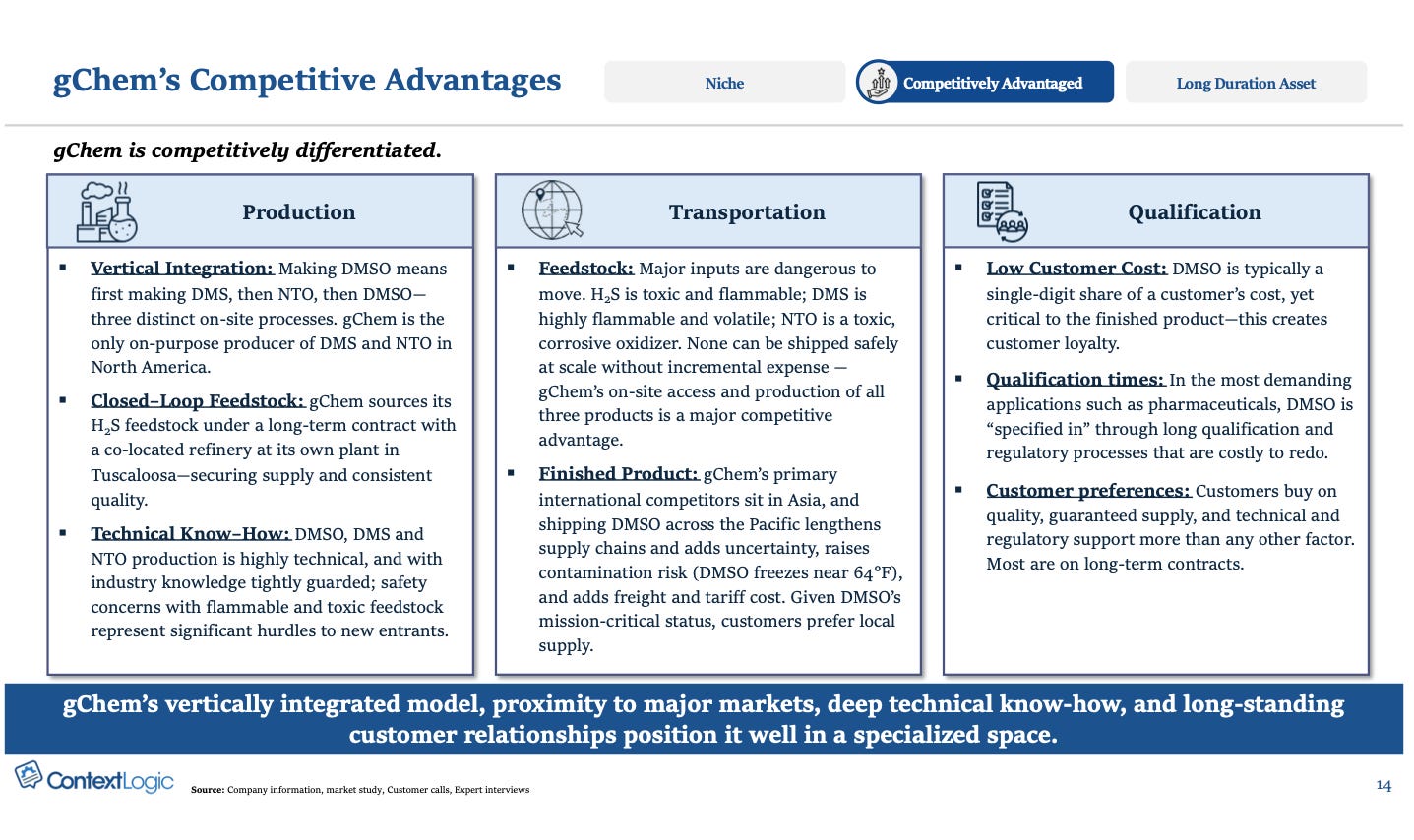
The investor materials detail several moats and they are all worth considering, but I think the most important are those that relate to their manufacturing integration and regulatory hurdles.
Vertical integration
The gChem plant functions as three chemical plants in one at its Tuscaloosa plant. They handle DMS production, NTO production and DMSO production and purification. In order to make DMSO, you need to first produce DMS (dimethyl sulfide), then NTO (dinitrogen tetroxide), then DMSO. As of 2023 they are the only plant to have integrated NTO production.
gChem also has a long term contractual agreement to obtain hydrogen sulfide (chemical required to make DMS) from a refinery located right beside its Tuscaloosa plant. The reason why this last part is particularly important is that hydrogen sulfide is extremely dangerous to transport to due to toxicity and combustibility, but also necessary to make DMS, so having the feedstock of hydrogen sulfide right next to them is an incredible production advantage.
Procipient
It’s not impossible to have a chemical plant that can make cheap industrial DMSO for stripping paint or some other industrial uses. But making DMSO that can be used in pharmaceutical development requires getting over regulatory hurdles such as maintaining a Type 2 Drug Master File with the FDA, and building a long term credible manufacturing history and with customer approvals and qualifications.
Procipient is gChems pharmaceutical grade of DMSO and its is the only one in the US backed by a Type 2 Drug Master File. This means that when a drug developer uses Procipient as an ingredient, the developer will reference gChem’s confidential manufacturing and quality information in its own submission to regulators. If the FDA approves it, it is approving it based specifically on how it behaves with Procipient, so if a drug manufacturer later decides that they want to switch to competitor, the FDA considers it a recipe change, which requires millions spent on new labs, stability studies and bioequivalence tests. At the same time, in order for a start up entrant to become a credible Procipient competitor, it would have to spend millions building a out its manufacturing process and validating analytical methods and getting a Type 2 Drug Master File.
The FDA has already approved 50+ drugs with reference to Procipients DMF, which means it is essentially designed into each of these drugs.
It should be noted that the moat is really a combination of a few things such as:
Drug Master File
gChems acceptable facility
gChems manufacturing history
gChems customer qualification
gChems 50 + installed drug approvals
The most important variables are the last three, which is why the DMF has been available to existing competitors, but they have not bothered to filed. So a competitor like Toray (Japanese producer) can file and have a DMF number issued relatively easy because they already presumably have an acceptable facility for manufacturing. However, getting the DMF doesn’t magically make them a legitimate competitor because it does not transfer gChems manufacturing history, qualifications and installed base.
The key thing to understand is that decades of reliable DMSO manufacturing and customer approvals simply cannot be accelerated with simply more capital. Similar to US Salts pharmaceutical grade salts, it takes years to get the track record necessary to win pharmaceutical customers.
gChem Deal And Financing
gChem is a large acquisition and not necessarily dirt cheap. By now it should be clear that they are targeting niche quality businesses and are willing to pay a reasonable price for them.
The deal is valued at $850m, and funded by 100% cash except the management equity roll-over (Frank Roederer, the CEO, is rolling equity). The financing package is $900m ($650 right offering + $250 debt).
Rights Offering
The rights offering is priced $650m at $9.00 per unit and offered pro rata to $LOGC shareholders and backstopped by Abrams, BC and Paul Levy. The offering issues roughly 72m LLC units. There are 46 million shares today so that implies that every share will likely be entitled to 1.57 rights.2
Dilution dynamics
Dilution occurs in ownership % to the existing PubCo shareholders who do not participate in the rights offering, and dilution is proportional to the degree of participation. So, those who fully participate will end up with roughly the same ownership % as they did prior to the offering. Those who don’t participate at all basically transfer ownership % over to those who do participate, including Abrams, BC Partners, and Paul Levy. This happened last time with the US Salt deal where minimal participation occurred, so Abrams, BC, and Levy backstopped much of the offering.
Even though the LLC unit count goes from ~102m-174m (+70%), the free cash flow per unit still increases 60-75%, which explains why the stock has done so well after the announcement.
Valuation
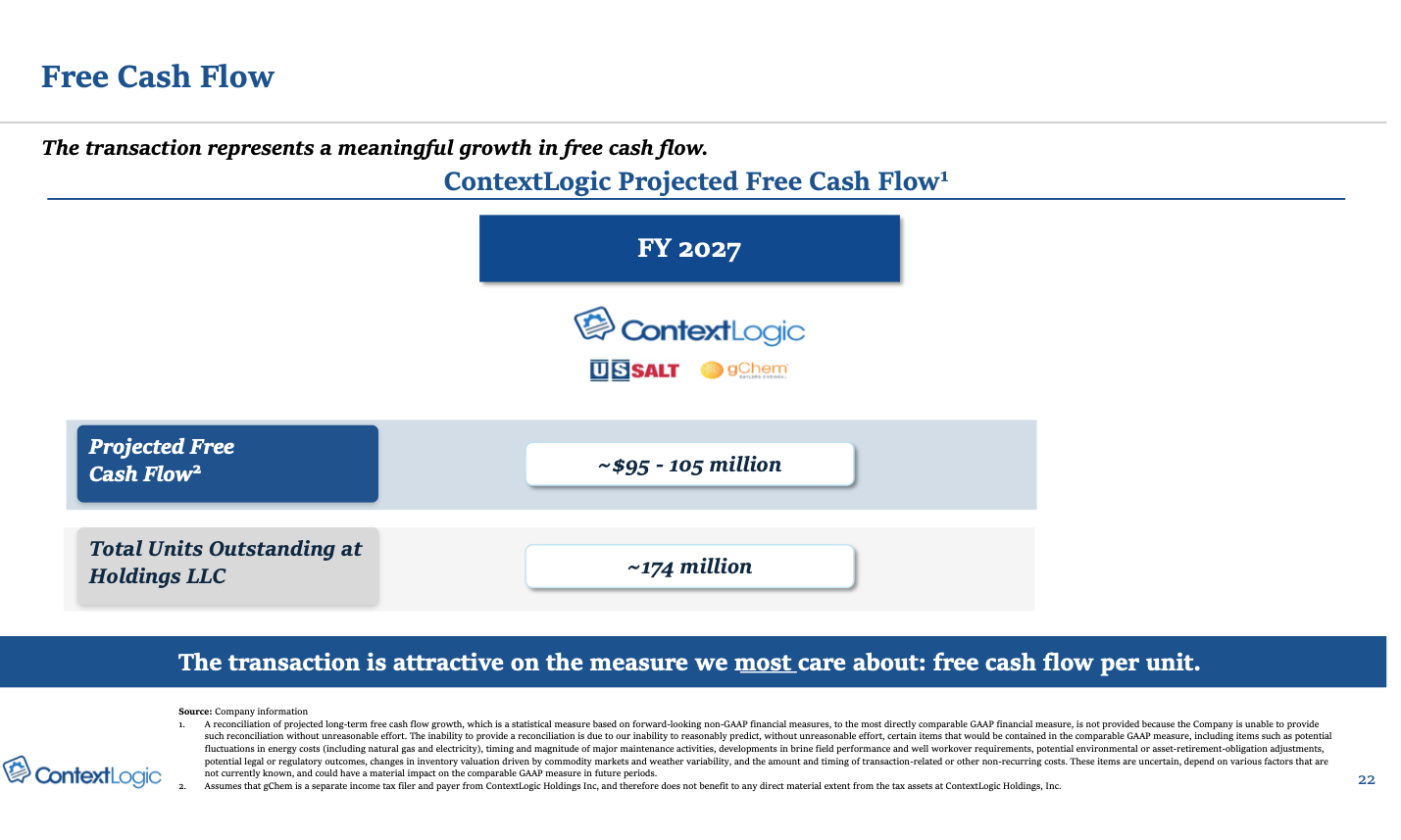
The post-deal 2027 FCF estimate is ~$0.55–0.60 per unit, which translates to roughly the same FCF per PubCo share given that each Class b unit corresponds to one PubCo share. The December 2025 presentation gave us a levered FCF figure in their bridge, so I’m assuming their 2027 FCF estimate is the same. This implies the stock trades around 18-19x forward levered FCF, which is not exactly cheap, but you are still paying a fair price for a quality acquisition platform led by an incredible group of investors.
This still leaves room for a potential re-rate higher into the mid 20’s if the market chooses to value gChem and US Salt at a higher rate. I’d imagine that mid 20’s is not out of the question should management continue to acquire niche advantaged businesses like these and they up-list to a major exchange.
A 25x multiple would imply a share price of ~$15 in 2027, or 33% upside from here at $11.25.
Final thoughts
David Abrams was taught by Seth Klarman and has his own impressive track record that is comforting. Having him invested and on the board certainly makes the thesis a much easier to digest given the messy fundamentals right now. Insiders continue to buy shares signaling that alignment is important.
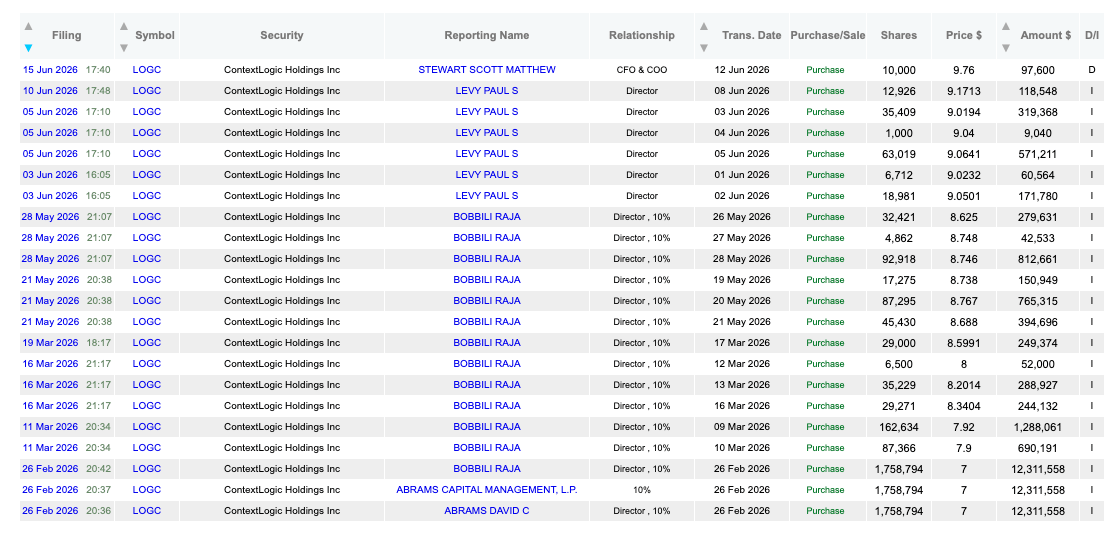
I have not decided yet, but at this point I am considering exercising my rights in the offering, which will allow me to build a larger position at $9 per share.
I am currently long in a ~5% position at $7.72
Disclaimer: Nothing here should be taken as financial advice.Please do your own due diligence and consult a financial advisor before buying or selling any securities. I am not a financial professional and none of my valuations or financial models should be taken as buy or sell signals.
Full disclosure: I am an $LOGC shareholder at the time this
$650M ÷ $9/share = ~72.2M new shares. 72.2m shares/46m existing PubCo shares = 1.57 rights per share.
You write, "Contaminated dialysis fluid would be an absolute catastrophe of biblical proportions for any pharmaceutical company."
Then you ignored this disclosure?
"US Salt Parent Holdings LLC (“US Salt”) is conducting an investigation associated with a confirmed report of contaminant in a production lot of salt shipped in February 2026. Although not legally required to do so, US Salt has self-reported this matter to the U.S. Food and Drug Administration. US Salt has implemented additional measures to further reduce the risk of contamination, has enhanced in-process testing, and has retained third party consultants to support its root cause investigation and advise on best practices. There have been no reported adverse events associated with this matter. There also have been no positive tests of contamination detected in US Salt’s expanded testing of both its historic and current retained lots. It is possible that US Salt may issue a partial or full recall of one or more lots of its salt. Any recalls by US Salt or US Salt customers could have a material adverse effect on US Salt’s business and financial performance, including due to direct and indirect costs of a recall, the destruction of product inventory and production delays
to investigate, identify, and address the underlying cause of a recall, liability to customers related to a recall, reduced sales of US Salt’s products, and adverse publicity that harms US Salt’s brand and reputation.
"
Thoughts?