
FTAI update.

FTAI Q2
FTAI has been an extremely volatile investment for me. I bought it last November at ~$150 and wrote an article a few weeks later pitching it around $175. The stock went on to touch ~$310 after the announcement of FTAI Power, just before going range-bound between $285 and $200 as the market is now demanding execution on power.
On July 29, FTAI reported earnings after hours, and the stock fell 19% to $160, then regaining itself the following day as investors saw it as an opportunity to get in. Lets go over some of the details.
The report numbers
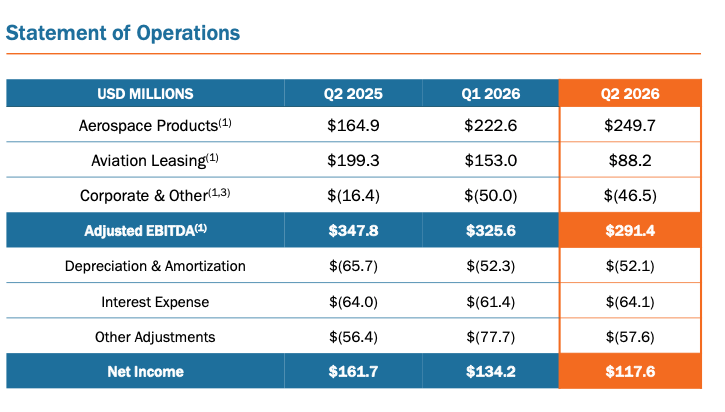
Where the margin went
AP EBITDA grew 51% which is rapid but it came with ~510bps of margin compression, which is hard to ignore because AP’s adj EBITDA margin was running at ~35% through 2025, then it stepped down to 30% last quarter, and now sits at 28.5%. My original bull case leaned on PMA approvals pushing margins toward 40%, which was a target management had repeated and affirmed as recently as Q4 2025. But they formally abandoned the 40% target on the Q2 call (July 30), and the retreat happened in stages, the progression was frustrating to watch.
Q3 2025: Margin at 35%, fully committed to 40%. “We continue to expect aerospace products margins to grow to 40% plus next year.”
Q4 2025: Margin at 35%, still verbally committed to 40%, but hedged with market share language. “Very confident... to grow that in 2026 to 40%.” But also: “We will prioritize market adoption over adding incremental margin.”
Q1 2026: Margin at 30%. They quietly stopped repeating 40%. The drop was explained by “larger mix of full performance restoration shop visits.”
Q2 2026: Margin at 28.5%. The 40% target is explicitly dead, replaced with 30% as steady state. “30% is the margin that we’re going to hold.”
This bothered me enough to reconsider the position.
Margin for share
A few years ago, FTAI served small lessors and regional operators buying light module swaps. The company had/has more control over the inputs on those transactions, so the margin is higher. That’s what produced the ~35% margin.
Today FTAI is attracting major airline customers who increasingly want full performance restorations rather than single-module swaps, which touches the whole engine and requires more parts and labor, including OEM parts that don’t come at the Chromalloy price.
This was the substance of their margin explanation on the Q1 call, and they reiterated it on Q2. New, larger customers want more involved work at lower margins, and FTAI is willing to do it to take share. I know that management framed this as a deliberate choice to sacrifice margin, but I’m not sure they have much choice. If they want to keep taking share, they have to take on bigger customers with bigger orders who want the heavy work. Unless I’m missing something?
Is it permanent?
The revenue mix shift is permanent. Management mentioned they may look at raising prices later after they’ve captured share, which could theoretically recover some margin. But for now, winning the larger customers means pricing to win them and doing the heavy work those airlines need.
Their Chromalloy parts savings are real, but FTAI is passing a portion of those savings through as it signs new contracts. That’s why margins have fallen even while PMA parts continued to get approved. Management made this trade deliberately, and 40% EBITDA margins aren’t coming back anytime soon.
In their defense, if they actually reach 25% market share, the absolute profit is enormous even at 25-30% margins. On a long enough horizon, that’s probably the right call.
Guidance
Management reaffirmed the $1b Aerospace EBITDA target for 2026, but H1 only did $472m. That leaves ~$578m for H2, which is a ~16% step-up from Q2.
FTAI Power
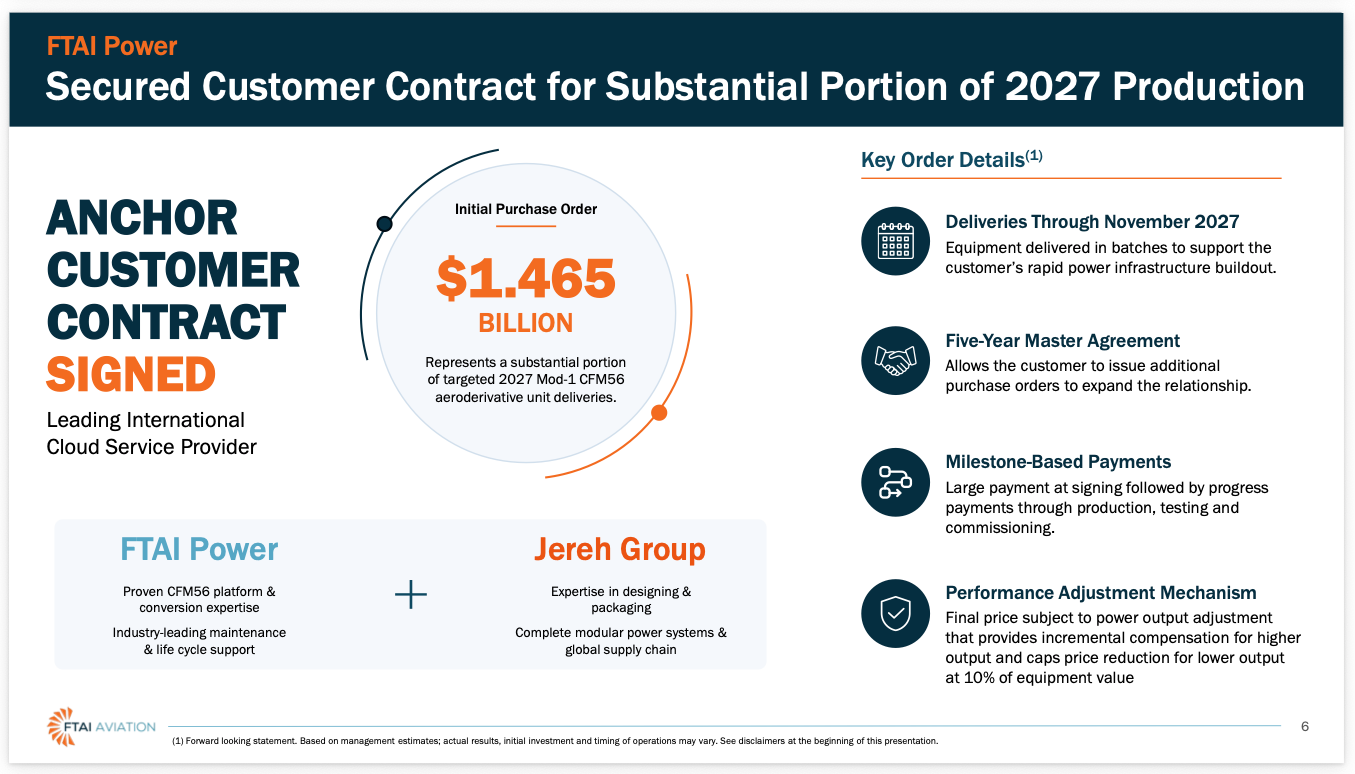
This quarter, Power showed up only as cost on the Corporate & other line.
They signed a $1.4b customer contract this quarter, and the 2027 guide now includes $450m of Power EBITDA. Management set a range of $450-750m and confirmed Power will become its own reporting segment next year. The big headline is J&F Power Systems (FTAI’s JV with Jereh Group) signed a 5-year master agreement with a US hyperscaler, plus an initial purchase order valued at $1.465b.
My thesis scorecard: B+
I got the quantitative story right on AP dominance, the SCI flywheel, Power optionality. The biggest thing I got wrong was margin. I expected expansion from PMA approvals, assumed it with management’s ~50% aspiration in the background. But reality went the other way.
SCI is doing better than I expected with a $6b fund rather than $4b. On Power, I was early because I penciled ~$35-40m for 2026, which won’t happen because it’s been pushed to 2027.
I assumed 40% Power margins, which now looks aggressive because management pegs Power margins in line with aerospace, and aerospace reset to ~30%. Not sure how that works out yet.
I flagged concern about complexity and too many moving parts in this business, and that still bothers me. The story depends on many partnerships and pieces working in sync to keep the machine running. It’s also hard for investors to understand and value, which explains the volatility. The market doesn’t know whether to value FTAI as a parts manufacturer, a lessor, an MRO, or an alternative power company.
Valuation and conclusion
I’m dialing back my original model because I got margins wrong, and I’m updating the Power assumptions.
$450m adj EBITDA from leasing in 2027 and 2028
$450m from Power adj EBITDA in 2027, $650m in 2028 (44% growth)
$1.4b from AP in 2027, $1.7b in 2028 (21% growth)
$180m in corporate and other in 2027, $200m in 2028 (Q2 run-rate annualized)
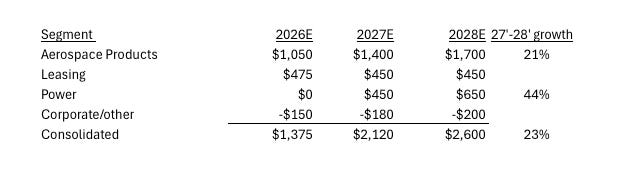
That gives us 2028 adjusted EBITDA of ~$2.6b, which was the low end of my previous model. I’m calling this the base case given that Power won’t live up to my optimistic build. I also lowered my multiple assumptions. Power’s proof-of-concept risk warrants a discount until they actually deliver.
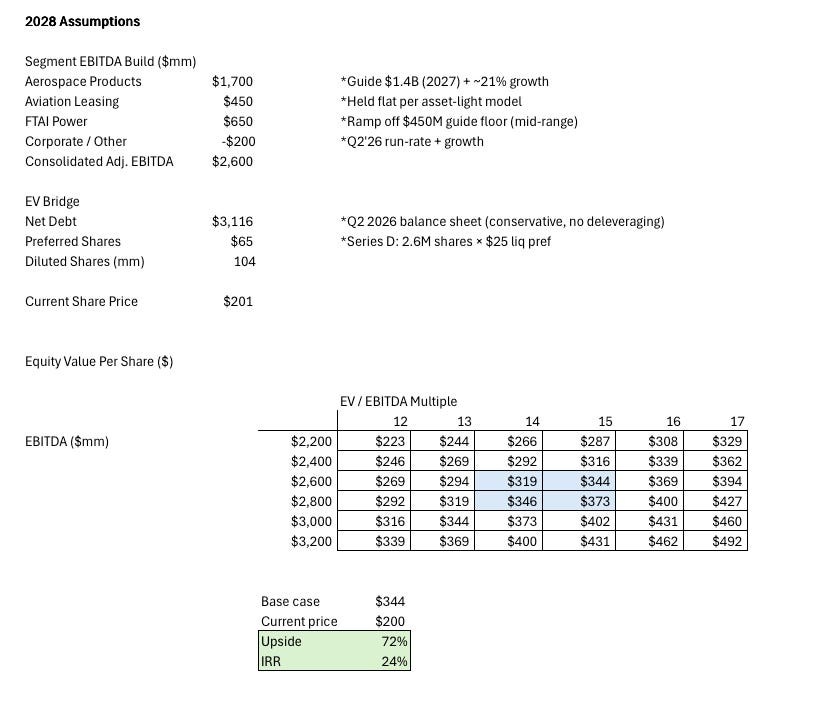
My base case is ~$350 (70%+ upside from here). If Power delivers on the high end of management’s 2027 guidance, you’re probably looking at $3b+ in 2028 EBITDA (AP $1.7b + Leasing $450m + ~$850m Power), which implies something closer to $400.
Some analysts have 12-month targets as high as $600. I’m not sure that’s realistic unless they overdeliver on Power and the multiple re-rates.
Power currently isn’t baked into the price at ~11x 2027 adj EBITDA and ~9x 2028. The market isn’t giving full credit for execution.
You don’t need a full re-rate to aerospace peer multiples. You just need the market to go from giving no credit to Power (9-11x) to giving some credit (14-15x). If Power begins to deliver, most of the re-rate would likely come next year.
Final thoughts
I still plan to own it. The margin compression made me rethink whether I want to, but I decided to keep holding because the company continues to grow rapidly and take share.
I’m not a buyer here, but I’d consider adding at lower prices.
thanks for reading!
Disclaimer: All my content is solely for educational purposes only. Nothing I say should be interpreted as financial advice. None of my financial models should be taken as buy or sell signals. Please consult a financial advisor before buying or selling any securities.
Short interest still high at 6% (maybe refinitiv didn’t update yet) which is surprising, shorts’ thesis still it’s over leveraged, and power isn’t going to work (which is kind of stupid imo)
Great article - how do you think about the catalyst path aside from execution for the market to value this combination of businesses properly given the complexity?
Also curious how you think about the sustainability of earnings/normalized earnings power as the current multiple on forecasted EBITDA growth screens as attractive? What would give you concern of over-earning?
This is a super interesting name I’m currently sharpening the pencil on.